 Australia
 Canada
 Cayman Islands
 Dominican Republic
 Hong Kong
 Indonesia
 Ireland
 Jamaica
 New Zealand
 Singapore
 Thailand
 United Kingdom
 United States
 Vietnam

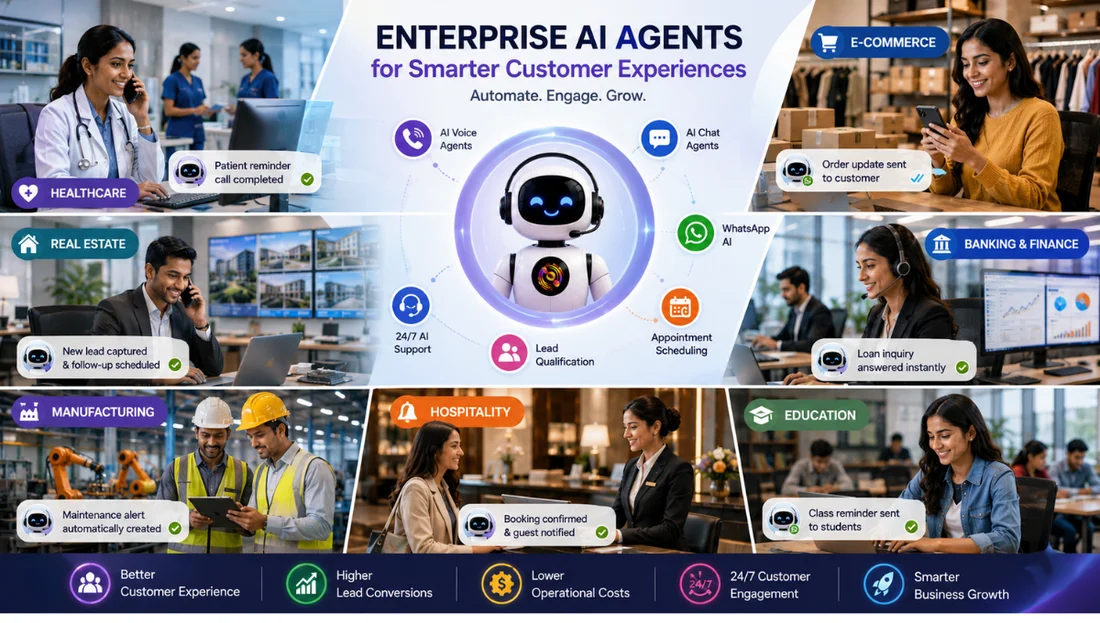
Businesses today operate in an environment where customer expectations are rising faster than ever before. Customers expect immediate responses, personalized interactions, and seamless experiences regardless of whether they contact a company through a website, mobile application, email, social media, WhatsApp, or phone.
Meeting these expectations consistently has become increasingly difficult using traditional customer service and business processes alone. Organizations must balance customer satisfaction with operational efficiency while managing growing workloads and controlling costs.
This challenge has led many businesses to adopt Enterprise AI Agents.
Enterprise AI Agents are far more than conversational chatbots. They are intelligent digital assistants capable of understanding natural language, accessing enterprise knowledge, automating workflows, supporting employees, and engaging customers throughout the entire business lifecycle.
Rather than replacing employees, Enterprise AI Agents complement human expertise by automating repetitive work, improving response times, and enabling teams to focus on activities that require creativity, strategic thinking, and relationship building.
Organizations that successfully integrate Enterprise AI into their operations are discovering that AI is no longer simply a technology investment—it has become a genuine competitive advantage.
The Competitive Landscape Has ChangedCompetition today extends beyond product quality and pricing.
Customers compare businesses based on their overall experience.
They evaluate:
Response speed
Service quality
Ease of communication
Personalization
Digital convenience
Availability
Consistency
A business that responds within seconds often creates a stronger first impression than one that takes several hours, even when both offer similar products or services.
Customer experience has become one of the strongest differentiators in modern business.
Organizations that consistently deliver exceptional experiences build stronger customer relationships, improve retention, and generate more referrals.
Why Traditional Business Processes Are No Longer Enough
Many organizations still rely heavily on manual processes for customer engagement.
Employees spend a significant portion of their day:
Answering repetitive questions
Scheduling appointments
Updating CRM records
Routing support tickets
Responding to emails
Managing customer follow-ups
Looking for internal information
These activities are necessary, but they also consume valuable time that could be spent solving complex problems or strengthening customer relationships.
As businesses grow, these manual processes become increasingly difficult to scale.
Hiring additional staff can help, but it also increases operational costs.
Enterprise AI Agents offer a more scalable solution.
Enterprise AI Agents Improve Customer ExperienceCustomer experience influences nearly every business outcome.
Satisfied customers are more likely to:
Purchase again
Recommend the business
Leave positive reviews
Remain loyal
Explore additional services
Enterprise AI Agents contribute to better customer experiences by ensuring customers receive immediate assistance whenever they need it.
Instead of waiting in long support queues, customers can receive answers instantly.
AI can help customers:
Find product information
Check order status
Schedule appointments
Resolve common issues
Receive personalized recommendations
Access support outside business hours
Fast, accurate communication creates confidence while reducing customer frustration.
Faster Decision-Making Across the OrganizationEnterprise AI is valuable not only because it automates conversations but also because it helps organizations make smarter decisions.
Every customer interaction generates useful information.
AI can identify patterns that reveal:
Customer preferences
Frequently asked questions
Popular products
Service bottlenecks
Buying behavior
Support trends
These insights enable leadership teams to improve products, optimize marketing campaigns, strengthen customer service, and allocate resources more effectively.
Instead of relying on assumptions, businesses make decisions based on real operational data.
AI Improves Productivity Without Increasing WorkloadsOne of the greatest advantages of Enterprise AI Agents is their ability to increase productivity across multiple departments.
Rather than asking employees to work faster, AI removes repetitive activities that consume time.
Examples include:
Customer SupportAI answers routine customer questions while support representatives focus on more complex requests.
SalesAI qualifies leads, schedules meetings, and records customer information before sales representatives engage.
Human ResourcesEmployees receive immediate answers to policy questions, onboarding guidance, and benefits information.
IT SupportAI assists with password resets, software access, and common troubleshooting requests.
FinanceRoutine invoice inquiries, payment tracking, and expense requests can be automated.
Employees spend less time performing repetitive administrative work and more time delivering value.
Consistency Creates Stronger Customer RelationshipsCustomers appreciate consistency.
Whether they contact a business through live chat, WhatsApp, email, or phone, they expect similar quality and accurate information.
Enterprise AI Agents help organizations maintain consistent communication by accessing centralized business knowledge.
Every customer receives:
Accurate information
Consistent messaging
Professional communication
Faster responses
Personalized assistance
Consistency strengthens trust while improving the overall customer experience.
Enterprise AI Supports Business ScalabilityGrowth often creates operational challenges.
As customer numbers increase, businesses experience:
More inquiries
Higher support volumes
Increased sales opportunities
Additional administrative work
Traditional approaches usually require hiring more employees.
Enterprise AI provides a different path.
AI Agents can handle thousands of conversations simultaneously without compromising response quality.
This allows organizations to expand operations while maintaining excellent customer service.
Instead of simply increasing headcount, businesses increase operational capacity through intelligent automation.
AI Complements Human ExpertiseDespite rapid technological progress, business success still depends on people.
Customers continue to value:
Professional advice
Strategic thinking
Industry expertise
Empathy
Negotiation skills
Relationship building
Enterprise AI does not replace these strengths.
Instead, it creates more opportunities for employees to use them.
By automating repetitive tasks, AI gives professionals more time to focus on meaningful customer interactions and high-value decision-making.
Enterprise AI Creates Value Across Every Department
One of the biggest strengths of Enterprise AI Agents is their ability to support multiple business functions instead of being limited to customer service. Organizations can deploy AI across departments to improve efficiency, reduce repetitive work, and provide consistent support to both customers and employees.
Customer SupportSupport teams often spend a significant amount of time answering similar questions every day. Enterprise AI Agents can provide instant answers to common queries, guide customers through troubleshooting steps, create support tickets, and escalate complex issues to human representatives when necessary. This reduces waiting times while improving customer satisfaction.
SalesSales teams benefit from AI by receiving qualified leads rather than spending time identifying potential customers manually. AI Agents can collect customer information, understand buying intent, schedule meetings, and share relevant product details before handing the conversation over to a sales representative.
Human ResourcesEmployees frequently contact HR with questions about leave policies, benefits, payroll, and onboarding. AI Agents can provide immediate answers, allowing HR professionals to focus on employee development, recruitment, and organizational planning.
IT SupportInternal IT departments receive many repetitive requests, including password resets, software installation assistance, and account access issues. AI Agents can resolve many of these requests automatically, reducing workloads and enabling IT specialists to focus on more technical challenges.
Connecting AI with Existing Business Systems
Enterprise AI becomes even more valuable when integrated with existing business applications.
Most organizations already use platforms such as:
Customer Relationship Management (CRM) software
Enterprise Resource Planning (ERP) systems
Help desk platforms
Knowledge management systems
Email and collaboration tools
Calendar applications
Instead of requiring employees to switch between multiple applications, AI can retrieve information, update records, and trigger workflows directly within these systems.
For example, an Enterprise AI Agent can:
Retrieve customer purchase history
Update CRM records automatically
Schedule meetings in shared calendars
Generate support tickets
Notify relevant departments
Send confirmation emails
Track workflow progress
This integration improves productivity while ensuring that information remains accurate and consistent across the organization.
Supporting Sustainable Business Growth
Business growth often creates operational complexity.
As organizations attract more customers, they also experience increasing inquiry volumes, larger sales pipelines, and higher support demands.
Without efficient processes, scaling operations becomes expensive and difficult to manage.
Enterprise AI Agents help organizations grow more efficiently by:
Managing thousands of conversations simultaneously
Providing multilingual customer support
Operating continuously without business-hour limitations
Reducing manual administrative work
Improving response times
Supporting global customer engagement
This scalability allows businesses to expand without proportionally increasing operational costs.
Measuring the Business Impact of Enterprise AI
Successful AI implementation should be measured using meaningful business outcomes rather than technology adoption alone.
Organizations commonly evaluate Enterprise AI using metrics such as:
Customer satisfaction scores
Average response time
First-contact resolution rate
Lead qualification efficiency
Appointment conversion rate
Employee productivity
Customer retention
Operational cost savings
Tracking these indicators helps organizations understand where AI creates the greatest value and identify opportunities for continuous improvement.
Responsible AI Builds Customer Confidence
As AI becomes more integrated into business operations, responsible implementation becomes increasingly important.
Organizations should establish clear policies regarding:
TransparencyCustomers should know when they are interacting with an AI assistant and have the option to speak with a human representative whenever required.
Data PrivacySensitive customer information should be protected through strong security measures and compliance with applicable regulations.
Human OversightAI should support decision-making rather than operate without supervision. Human expertise remains essential for handling complex situations and maintaining customer relationships.
Continuous ImprovementEnterprise AI systems should be reviewed regularly to improve response accuracy, expand knowledge, and adapt to changing business requirements.
Responsible AI implementation strengthens customer trust while supporting long-term business success.
Looking Ahead: The Future of Enterprise AI
Artificial intelligence continues to evolve at a rapid pace.
Future Enterprise AI Agents will become even more capable of understanding business context, collaborating across departments, and supporting increasingly sophisticated workflows.
Businesses can expect continued innovation in areas such as:
Predictive customer support
Voice-enabled enterprise assistants
AI-powered knowledge management
Intelligent workflow orchestration
Personalized employee assistance
Advanced business analytics
Multilingual customer engagement
Organizations that begin adopting Enterprise AI today will be better prepared to meet future customer expectations while remaining competitive in an increasingly digital marketplace.
Conclusion
Enterprise AI Agents have evolved far beyond simple automation tools. They are becoming strategic business assets that help organizations improve customer experiences, increase operational efficiency, and support sustainable growth.
By automating repetitive work, integrating with enterprise systems, and providing intelligent assistance across departments, AI enables employees to focus on the work that creates the greatest value—solving problems, building relationships, and making informed business decisions.
Businesses that successfully combine Enterprise AI with skilled professionals will be better positioned to adapt to changing customer expectations, improve productivity, and strengthen their competitive advantage.
As organizations continue their digital transformation journeys, Enterprise AI Agents will play an increasingly important role in shaping the future of modern business.
About Aisa-X AI
Aisa-X provides enterprise-grade AI Voice and Chat Agents that help organizations deliver exceptional customer experiences while improving operational efficiency. From automating customer support and qualifying leads to integrating with CRM systems and streamlining business workflows, Aisa-X enables businesses to scale intelligent customer engagement across websites, WhatsApp, voice channels, and enterprise applications. By combining AI-powered automation with human expertise, organizations can build stronger customer relationships and achieve sustainable business growth. Read our Full Blog: Enterprise AI Agents: The Missing Link Between Customer Experience and Business Growth Visit: Aisa-X AI - The conversational AI Platform - AI Voice and Chat Agents for Businesses